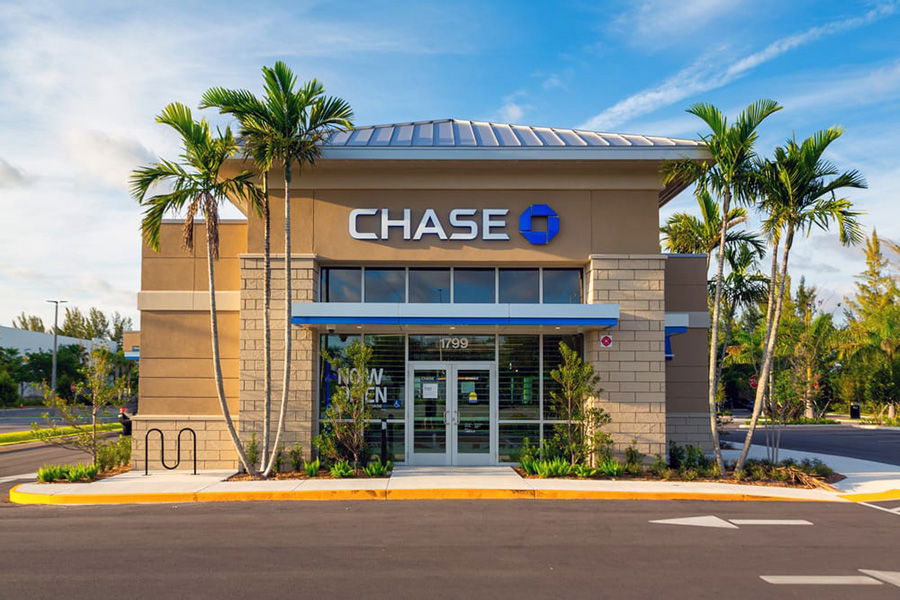
No bank has retail branches in all 50 states. Chase comes closest, with locations throughout the 48 contiguous states, but it doesn’t have branches in Alaska or Hawaii.
If you need nationwide banking access, you still have plenty of options. Large national banks offer thousands of branches, participating credit unions provide access to shared branches in every state, and online banks let you manage your money from anywhere in the country.
We reviewed FDIC branch records and information from individual financial institutions to compare their geographic coverage. Here’s which banks have the most locations, how nationwide credit union access works, and which online banking options are worth considering.
Banks With Branches in the Most States
The largest national banks have extensive branch networks, but none covers the entire country. Chase has the broadest retail presence, while Wells Fargo and Bank of America also operate thousands of locations across multiple regions.
The following table compares ten banks with some of the widest geographic coverage in the United States.
| Bank | States and D.C. With Offices | Approximate Branches |
|---|---|---|
| Chase Bank | 49 | 5,100+ |
| Wells Fargo | 40 | 4,100+ |
| Bank of America | 40 | 3,500+ |
| U.S. Bank | 29 | 2,100 |
| PNC Bank | 28 | 2,400+ |
| BMO Bank | 23 | 980+ |
| First Citizens Bank | 23 | 500+ |
| Huntington Bank | 21 | 1,400 |
| Truist Bank | 18 | 1,900+ |
| Woodforest National Bank | 17 | 740+ |
Source: FDIC branch records and bank disclosures from 2026. State counts include Washington, D.C., where applicable. Some institutions have limited-service offices that don’t offer everyday consumer banking. Branch counts are approximate and can change throughout the year.
Chase is the largest bank in the United States by assets. Its branch network covers every contiguous state, and it operates thousands of ATMs nationwide. That makes it one of the strongest choices for customers who travel frequently or expect to move.
Wells Fargo has a particularly strong presence in California, Texas, Florida, and several western states. Unlike Chase, it also operates branches in Alaska.
Bank of America’s network is concentrated in major metropolitan areas, particularly along the East Coast, in California, and in Texas. It also offers extensive ATM access and digital banking services.
U.S. Bank and PNC have large branch networks, although their locations are more concentrated in certain regions. Both can be convenient choices if you live within their established markets.
Other banks have expanded their footprints through acquisitions. Huntington’s 2026 merger with Cadence Bank extended its reach into additional southern states, while First Citizens expanded through the purchase of BMO branches.
Keep in mind that a bank’s total number of branches doesn’t guarantee convenient access where you live. You should still check its locations near your home, workplace, and any cities you visit regularly.
Which Banks Have Branches in Alaska and Hawaii?
Alaska and Hawaii are the two states that prevent Chase from having branches in all 50 states. Both states have established banking options, but the major national banks have a much smaller presence.
Banks With Branches in Alaska
Wells Fargo operates branches in Anchorage, Fairbanks, Juneau, and other Alaska communities. KeyBank also serves the state with physical branch locations.
Alaska has several established regional banks, including First National Bank Alaska and Northrim Bank. These banks may provide more convenient access in communities where larger national banks have fewer locations.
If you need in-person banking in Alaska, compare nearby branch locations before choosing a national bank.
Banks With Branches in Hawaii
Hawaii’s banking market is dominated by local institutions. Bank of Hawaii and First Hawaiian Bank operate extensive branch networks across the islands.
American Savings Bank and Central Pacific Bank are two other options with established physical locations.
Some mainland banks have specialized offices in Hawaii, but these don’t necessarily offer regular checking account services. For everyday banking, the local institutions generally provide more practical branch access.
Credit Unions With Nationwide Branch Access
Credit unions can offer nationwide in-person banking even if they don’t operate their own branches in every state. The CO-OP Shared Branch network gives members of participating credit unions access to more than 5,000 branches across all 50 states.
At a participating shared branch, you can complete many of the same transactions you’d handle at your home credit union. These may include cash deposits, withdrawals, transfers, loan payments, and cashier’s checks.
You’ll typically need your credit union’s name, account number, and government-issued photo ID. Certain transactions may require additional identity verification, and services vary by location.
You can locate participating branches through the CO-OP Shared Branch Locator.
It’s important to distinguish shared branch access from nationwide membership. Some credit unions accept members from all 50 states but don’t participate in shared branching. Others operate primarily online and rely on ATM networks.
Credit Unions That Serve Members Nationwide
Several major credit unions serve members across the country. However, membership requirements, physical branch networks, and ATM access differ.
| Credit Union | Nationwide Banking Access |
|---|---|
| Connexus Credit Union | 5,000+ shared branches and nationwide ATM access |
| Alliant Credit Union | 80,000+ fee-free ATMs and digital banking |
| Navy Federal Credit Union | Hundreds of branches and extensive ATM access |
| PenFed Credit Union | Nationwide membership, digital banking, and ATM access |
Connexus Credit Union is particularly useful for customers who want access to physical branches. It participates in the CO-OP Shared Branch network, so members can conduct eligible transactions at thousands of participating credit unions outside their home state.
Alliant Credit Union operates primarily online and gives members access to more than 80,000 fee-free ATMs. It offers interest-bearing checking, savings accounts, and competitive deposit products. Membership is broadly accessible through the Alliant Credit Union Foundation.
Navy Federal Credit Union is the largest credit union in the United States. It has hundreds of branches in the U.S. and overseas, but membership is generally restricted to eligible military members, veterans, Department of Defense personnel, and their families.
PenFed Credit Union serves members in all 50 states. Although it originally focused on military and defense communities, membership is now open to a much broader group of applicants. Its physical branches are limited compared with those of major national banks.
Other large credit unions have strong regional networks. State Employees’ Credit Union serves eligible members throughout North Carolina, while America First Credit Union operates branches across several western states.
For nationwide in-person banking, a credit union that participates in shared branching can be more useful than one with a large regional branch network.
4 Online Banks and Banking Apps With Nationwide Access
If you don’t need traditional bank branches, online banking can be a convenient alternative. Many online accounts offer lower fees, competitive savings rates, early direct deposit, and nationwide ATM access.
You can also deposit cash through participating retail stores with certain accounts. That makes digital banking more practical than it used to be, even for people who occasionally handle cash.
Here are four of the best online banking options for nationwide access.
1. SoFi
SoFi offers Checking and Savings accounts with competitive interest rates and no monthly maintenance fees. Its Savings account can earn a higher APY when you set up eligible direct deposit or meet the qualifying deposit requirements.
One of SoFi’s biggest advantages is that you can manage checking and savings together. The accounts offer early direct deposit up to two days, access to more than 55,000 fee-free Allpoint ATMs, and automatic savings tools.
SoFi also offers several features that make it easier to manage your money:
- Savings Vaults: Set money aside for specific goals without opening separate savings accounts. You can automate contributions and earn interest on your Vault balances.
- Early direct deposit: Get access to your paycheck up to two days early when your employer submits payroll information.
- Overdraft coverage: Eligible customers can receive up to $50 in overdraft coverage without a fee when they meet the qualifying direct deposit requirements.
- Automatic savings: Schedule transfers and set up tools that move money toward your savings goals without manual deposits.
- Nationwide ATM access: Withdraw cash at more than 55,000 Allpoint ATMs without an in-network ATM fee.
SoFi also offers personal loans, student loan refinancing, mortgages, credit cards, investing, and other financial products. That gives customers the option to manage several financial accounts through one platform.
Additional member benefits include access to financial planning, referral rewards, member discounts, and community experiences. Some benefits require a qualifying membership level.
For someone who wants an alternative to a traditional national bank, SoFi combines everyday checking features with high-yield savings and broader financial services.
2. Current
Current offers mobile banking services with no monthly subscription fee for its standard account, no minimum balance requirement, and access to more than 40,000 fee-free Allpoint ATMs.
Current also supports cash deposits at approximately 60,000 participating retail locations, including stores such as Walmart and CVS. This gives customers a practical way to add cash without visiting a traditional bank branch. Retail cash deposit fees may apply.
Beyond everyday spending, Current offers several features that help customers save money, earn rewards, and manage their accounts.
- Savings Pods: Create up to three savings goals and earn an annual bonus of up to 4.00% on eligible balances when you meet the qualifying payroll deposit requirements. The higher rate applies to the first $2,000 in each Savings Pod, up to $6,000 total.
- Early direct deposit: Receive your paycheck up to two days early when Current receives the payment information from your employer.
- Fee-free overdraft: Eligible members can access overdraft protection without overdraft fees after they receive qualifying direct deposits of at least $200 within the required period.
- Cash back rewards: Earn points on eligible card purchases and redeem those points for cash back. Qualification and purchase-category requirements apply.
- Credit building: Current’s secured Build Card can help establish payment history without a traditional credit check to apply. On-time payments can help improve your credit score.
- Teen banking: Parents can give teens access to a debit card, transfer money instantly, set spending restrictions, and receive transaction notifications.
Current also offers spending insights, mobile check deposits, and automatic savings through Round-Ups. These features help customers monitor purchases and put money toward savings goals.
Current is a financial technology company rather than a bank. Banking services are provided through FDIC-insured partner banks.
For people who want a mobile account with savings tools, overdraft protection, rewards, and family banking features, Current offers more than basic checking services.
3. Chime
Chime offers checking and savings services without monthly maintenance fees, minimum balance requirements, or traditional overdraft fees.
Members can access more than 47,000 fee-free ATMs nationwide and deposit cash at over 90,000 participating retail locations. Cash deposits are free at Walgreens and Duane Reade, although other retailers may charge fees.
Chime also offers early direct deposit up to two days before payday and several tools that help customers manage unexpected expenses and build savings.
- SpotMe: Eligible members can overdraw their accounts by up to $200 without an overdraft fee. Limits depend on account history and other eligibility factors.
- Automatic savings: Set aside money through purchase Round Ups, direct deposit allocations, and recurring transfers.
- High-yield savings: Earn a competitive APY on savings without a minimum balance requirement. Certain membership benefits may provide higher rates.
- Chime Card: Build credit history through eligible purchases and on-time payments with a secured credit card that has no annual fee, no interest, and no credit check to apply.
- Cash back rewards: Eligible Chime Card members can earn up to 5% cash back in a selected spending category when they meet qualifying direct deposit requirements.
- MyPay: Eligible members can access part of their pay before payday. Standard delivery is free, while optional instant access carries a fee.
Chime’s mobile app also offers spending notifications, card controls, and the ability to send money to other people. Its automatic savings tools can be particularly useful for customers who want to build savings without making manual transfers.
Chime is a financial technology company, not a bank. Its banking services are provided through FDIC-insured partner banks.
For customers who want early paycheck access, fee-free overdraft protection, savings tools, and credit-building features, Chime offers a practical alternative to traditional branch banking.
4. Ally Bank
Ally Bank offers checking, savings, money market accounts, and CDs without monthly maintenance fees or minimum balance requirements.
Its Spending Account provides access to more than 75,000 fee-free Allpoint and MoneyPass ATMs. Ally also reimburses up to $10 per statement cycle for qualifying out-of-network ATM fees nationwide.
Customers can deposit cash into eligible Spending Accounts at Walmart Money Centers and customer service desks without a fee.
Ally’s savings account offers competitive interest rates and tools such as Savings Buckets, Round Ups, and recurring transfers. These features make it easier to separate money for different savings goals.
Ally also provides early direct deposit, 24/7 customer support, mortgages, auto financing, and investment services.
It’s a solid choice for customers who want a full-service online bank with extensive ATM access and several ways to manage their savings.
How to Find a Bank With Branches Near You
Even if a bank operates thousands of locations, it may not have a convenient branch near your home or workplace.
Before opening an account, use the bank’s official branch locator to search your ZIP code. Check whether nearby locations offer full-service banking, ATM access, or limited services.
A branch that appears in a nationwide database might not provide everything you need. Some offices handle only business banking, investment services, or appointments.
If you’re considering a credit union, confirm whether it participates in shared branching. You should also check which transactions are permitted at participating locations.
For customers who travel or move frequently, it makes sense to check branch and ATM access in more than one state.
How to Choose a Bank With Nationwide Access
A bank with branches in dozens of states isn’t automatically the best choice. Your banking habits matter more than the total number of locations.
Consider how often you use cash, whether you need teller assistance, and how much you could save on account fees.
- Physical branches: Choose a national bank if you regularly visit tellers, deposit checks in person, or need services such as cashier’s checks.
- ATM access: Look for a large fee-free network if you frequently withdraw cash or travel outside your home state.
- Cash deposits: Check whether an online account supports deposits at retail locations and whether those deposits carry fees.
- Account fees: Compare monthly maintenance charges, minimum balance requirements, overdraft fees, and other transaction costs.
- Savings rates: Consider an online bank or credit union if earning a higher APY is more important than having nearby branches.
- Shared branches: Look for a participating credit union if you want access to in-person transactions throughout the country.
If you already have a bank account that meets your needs, you may be able to keep it when you relocate. Most national banks let existing customers continue using their accounts across state lines.
However, if you move somewhere without nearby branches or ATMs, it may make sense to switch banks.
Chase is a strong option for customers who want the widest traditional branch network. A participating credit union can provide broader shared branch coverage, while online banking services such as SoFi, Current, Chime, and Ally can offer lower fees and useful account features without requiring a physical branch.
Frequently Asked Questions
Can you open a new account at a shared credit union branch?
Usually not. Shared credit union branches generally allow members to perform transactions on existing accounts, but they don’t typically open new accounts for members of other credit unions.
You would need to apply through your own credit union, either online or at one of its branches.
Will your bank routing number change if you move to another state?
Usually, your existing routing number stays the same when you move and keep your current bank account. However, some national banks use different routing numbers in different states.
Check your account details before updating direct deposits or automatic payments.
Do banks charge extra fees for using branches in another state?
Most national banks don’t charge an additional fee simply because you visit one of their branches in another state.
However, fees may apply to certain transactions, such as wire transfers or cashier’s checks. Your account agreement determines which services carry charges.
Can you have bank accounts in two different states?
Yes. You can maintain accounts at banks in different states as long as you meet each institution’s eligibility requirements.
This can be useful if you divide your time between two locations or want access to local banking services in more than one state.