The Firestone Credit Card is issued by Credit First National Association (CFNA), a consumer finance company that’s a subsidiary of Bridgestone Americas. Unlike most store cards that partner with a third-party bank, CFNA was built in-house by Bridgestone specifically to finance tire and auto service purchases across its retail network.
The card is accepted at more than 8,000 Bridgestone and Firestone retailers nationwide, including Firestone Complete Auto Care, Tires Plus, Wheel Works, and Hibdon Tires Plus. For drivers facing unexpected repair bills or tire replacements, it’s designed to turn a single large expense into manageable payments.
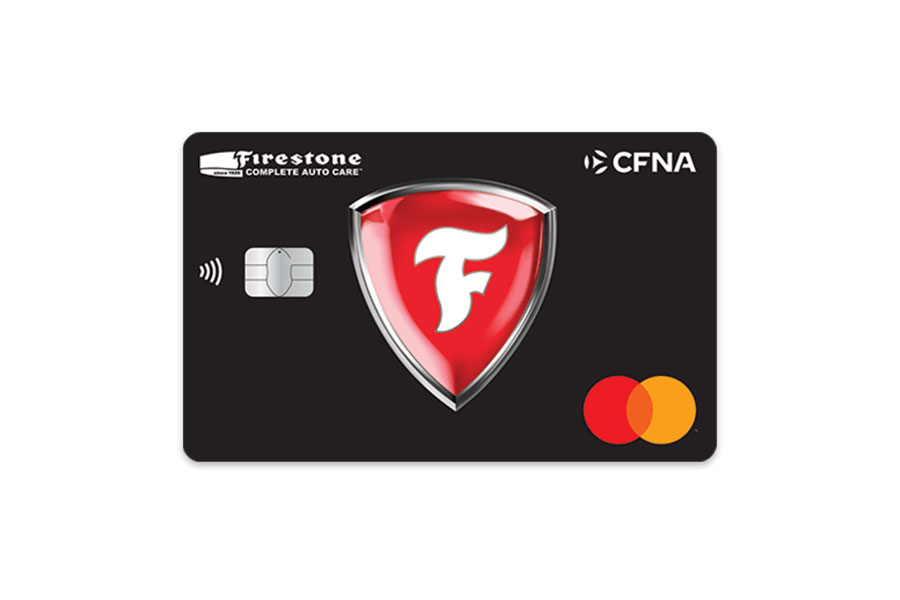
CFNA offers two versions: a store-only private label card usable only at participating Bridgestone network retailers, and a Firestone Mastercard that can be used anywhere Mastercard is accepted. Which one you receive depends on your credit profile during the application review.
Minimum Credit Score Needed for the Firestone Credit Card
Most approved applicants for the private label store card have a credit score of at least 640, placing the card in the fair to good credit range. That threshold is consistent with CFNA’s underwriting approach across its card portfolio.
Applicants above 670 have stronger odds of being approved directly for the Firestone Mastercard version, which offers broader utility and rewards on general purchases.
The distinction matters. If your credit score is borderline, CFNA may approve you for the store-only version rather than the Mastercard. That’s still useful for auto repairs but doesn’t provide the everyday utility of a Mastercard-branded product.
Auto Service Financing and What It Means for Your Application
Firestone Credit Card applicants typically fall into one of two categories. The first is the emergency applicant facing an unexpected repair bill, transmission issue, or failed inspection. The credit line is opened at the counter to cover a specific $500 to $2,500 job.
The second is the planned applicant opening the card ahead of a tire replacement, brake service, or major maintenance, often after comparing financing options.
CFNA underwrites for both scenarios but evaluates them slightly differently. The emergency applicant is more likely to be approved on the spot for the specific purchase amount needed. Meanwhile, the planned applicant may receive a higher initial credit line based on their overall profile.
Because CFNA is a specialty lender owned by Bridgestone rather than a general-purpose bank, it has flexibility to approve applicants that a bank-issued card might decline. This is especially true when the requested credit line matches a specific repair bill.
What Else Does CFNA Look At?
CFNA’s review focuses on these factors:
- Income relative to the requested credit line: Because the card is often opened to finance a specific repair, CFNA weighs whether your income supports the monthly payments on that purchase. Reporting accurate income is critical.
- Recent payment behavior: The past twelve months carry more weight than long-term history. A 30-day late in that window can complicate an otherwise qualifying profile.
- Debt-to-income ratio: CFNA looks at how much of your monthly income is already committed to existing debt payments. High existing obligations reduce both approval odds and credit line size.
- Prior CFNA account history: CFNA services over 4.6 million accounts across its card portfolio. A prior Firestone, Bridgestone, or Tires Plus account that closed negatively is often a harder obstacle than credit score improvement can overcome.
- Credit utilization: High balances on existing cards signal financial strain. Getting total usage below 30% before applying strengthens both your score and your overall profile.
What Do You Get with the Firestone Credit Card?
The card’s main benefit is 6-month deferred interest financing on purchases of $149 or more at participating Bridgestone network retailers. The $149 threshold is low enough that routine services like tire installation, brake jobs, and scheduled maintenance typically qualify.
The critical detail is that this is deferred interest, not 0% APR. Interest accrues from the purchase date at the standard 34.99% APR (for the store card) or 33.24% APR (for the Mastercard, current as of January 2026). If the promotional balance is paid in full within 6 months, all accrued interest is waived. If any balance remains after 6 months, CFNA charges the accumulated interest retroactively on the original purchase amount.
On a $1,200 tire and alignment package with 6-month deferred interest, missing the payoff deadline can trigger roughly $200 in retroactive interest. Dividing the purchase by 6 and setting that as your automatic monthly payment, then paying it off a cycle early, is the only reliable way to use this financing safely.
New cardholders also receive 5% off their first purchase, and the card has no annual fee.
The Firestone Mastercard version adds rewards through the myCFNA Rewards Program on purchases made where Mastercard is accepted, plus utility as a general-purpose card. The store-only version works only within the Bridgestone retail network.
How to Strengthen Your Application Before Applying
These steps address what CFNA weighs most heavily:
- Check your prior CFNA history: A previous Firestone, Bridgestone, or Tires Plus account that went negative can affect this application regardless of your current credit score. Address prior issues before applying.
- Match your credit request to your actual purchase: If you’re opening the card to finance a $1,200 repair, applying with that specific purchase in mind typically clears review more smoothly than requesting the maximum credit line.
- Pay down revolving balances: Lower utilization improves both your credit score and your debt-to-income ratio, which CFNA weighs meaningfully.
- Report full household income: Include all legitimate income sources. Higher reported income translates to a higher credit line, which matters when you’re financing a specific repair amount.
- Space out hard inquiries: Avoid other credit applications in the 60 to 90 days before applying. Recent inquiry activity is a meaningful risk signal at the fair credit tier.
Ready to take action on your credit?
Get your personalized plan in 30 seconds. Free, no credit check.

Bottom Line
The Firestone Credit Card is a practical financing tool for drivers with fair to good credit. It allows them to spread out the cost of tire replacements, repairs, and maintenance at the Bridgestone retail network.
A credit score of 640 or above, paired with steady income and a clean recent payment record, puts you in reasonable position with CFNA. Applicants above 670 have better odds of receiving the Mastercard version, which offers broader utility and rewards.
Apply with a specific purchase in mind, pay down revolving balances before submitting the application, and treat the 6-month deferred interest promo as a strict payoff schedule rather than flexible payments. Those three moves address the most common pitfalls for this card.