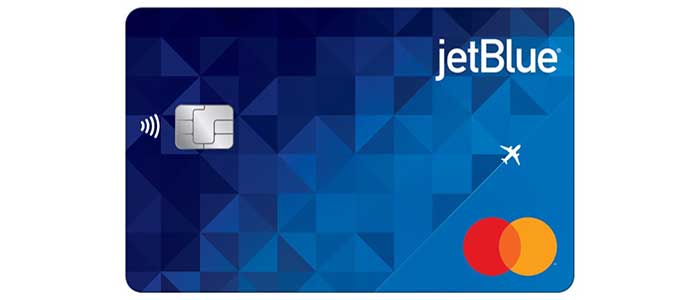
Barclays issues four JetBlue credit cards, each designed for a different type of JetBlue traveler. The lineup runs from a no-annual-fee entry card to a premium card built around Mosaic elite status.
Which card you’re targeting shapes the credit score you’ll need and the benefits you’ll be working toward. Knowing where each card sits before you apply is worth the few minutes it takes.
Here’s how the four cards break down, what credit score Barclays looks for at each tier, and how to put together the strongest possible application.
The Four JetBlue Credit Cards
Each card targets a different frequency and style of JetBlue travel.
The JetBlue Card is the no-annual-fee entry point into the program. It earns TrueBlue points on JetBlue purchases, dining, and groceries, with a lower rate on everything else. The welcome bonus is modest compared to the rest of the lineup, but the absence of an annual fee makes it a low-risk starting point for occasional JetBlue flyers.
The JetBlue Plus Card steps up to a $99 annual fee and delivers a significantly larger welcome bonus, a 10% points rebate on redemptions, an annual $100 statement credit toward JetBlue vacations packages, and a free checked bag on JetBlue flights. For travelers who fly JetBlue more than a few times a year, the annual fee pays for itself quickly through the bag fee savings alone.
The JetBlue Business Card is designed for small business owners who fly JetBlue regularly. It earns points on business spending and JetBlue purchases, with a welcome bonus and travel perks similar to the Plus card. The $99 annual fee applies here as well.
The JetBlue Premier Card sits at the top of the lineup at $299 annually. It offers the largest welcome bonus, five miles toward Mosaic status upon approval, and the fastest ongoing path to elite status for frequent JetBlue flyers. This card makes financial sense primarily for travelers who fly JetBlue enough to extract value from Mosaic benefits.
Credit Score Requirements for a JetBlue Card
Barclays doesn’t publish specific credit score minimums, but applicant data points to consistent benchmarks across the lineup.
The JetBlue Card is the most accessible, with most approved applicants carrying a credit score of 660 or higher. The Plus and Business cards generally require a credit score closer to 700, consistent with Barclays’ expectations for cards carrying an annual fee and more substantial travel benefits.
The Premier Card, as a premium product with a $299 annual fee and elite status acceleration, typically sees approvals clustering around 720 and above.
Barclays is known for being somewhat conservative with approvals, which means the credit score thresholds above are closer to floors than averages. Applicants with credit scores right at those numbers will find the rest of their financial profile carrying more weight than it might at a less selective issuer.
What Else Does Barclays Look At?
Barclays reviews your full financial profile for all four JetBlue cards. These factors shape the decision alongside your credit score:
- Income and employment history: Barclays places meaningful weight on stable income and consistent employment. A verifiable income history strengthens applications at every tier of the JetBlue lineup.
- Existing Barclays relationship: Applicants who already hold multiple Barclays cards can run into friction with new applications. Barclays tends to be conservative about approving cardholders who already carry several of their products.
- Recent payment record: The past twelve months carry more weight than your overall credit history. A late payment during that window raises concerns at any tier, but the higher the card, the less tolerance Barclays has for recent blemishes.
- Debt-to-income ratio: High existing monthly debt obligations relative to your income make a new credit line look riskier regardless of your credit score.
- Recent hard inquiries: Several recent applications for new credit signal active credit-seeking behavior that works against an application at a conservative issuer like Barclays.
Barclays’ Reconsideration Option
Barclays is one of the issuers most receptive to reconsideration calls after a denial. If you receive an adverse action notice and believe your application was borderline, calling Barclays’ reconsideration line gives you a chance to speak with an analyst who can manually review the decision.
This works best when you have a specific, addressable explanation for the weak spot in your application. A temporarily high utilization ratio that has since dropped, or a short credit history that has grown meaningfully since you applied, are the kinds of situations where reconsideration can change the outcome. A denial rooted in a genuinely thin credit profile or too many existing Barclays cards is harder to overcome through reconsideration alone.
How to Match Your Application to the Right Card
The JetBlue lineup rewards applicants who match their target card to their current credit profile rather than reaching for a higher-tier card before their profile supports it. Applying for the Premier card with a 680 credit score wastes a hard inquiry and potentially delays your ability to reapply. Starting with the no-annual-fee card, building your Barclays relationship, and upgrading later is a more reliable path to the higher-tier benefits.
If your credit score is around 660, the JetBlue Card is the right starting point. At 700 or above with a clean recent record, the Plus card is the more rewarding target. The Premier card is worth waiting for until your credit score is comfortably above 720 and you’re flying JetBlue frequently enough to justify the annual fee.
How to Strengthen Your Application Before Applying
These steps address the factors Barclays weighs most heavily across all four JetBlue cards:
- Check your existing Barclays card count: If you already hold several Barclays products, spacing out this application gives you a cleaner shot. Barclays is more conservative than most issuers about approving applicants with multiple existing Barclays accounts.
- Get your credit score into the right range for your target card: Each tier has a different effective threshold. Hitting that number before applying eliminates the most common credit score-related denial reason.
- Protect your recent payment record: Six to twelve months of on-time payments across all accounts is a strong signal to Barclays regardless of what your credit report shows before that window.
- Pay down revolving balances: Getting total utilization below 30% across all accounts strengthens both your credit score and the overall profile Barclays reviews.
- Dispute errors on all three credit reports: Pull your credit reports from Equifax, Experian, and TransUnion separately and flag inaccurate items with each bureau directly. An error on one credit report won’t automatically appear on the others.
Ready to take action on your credit?
Get your personalized plan in 30 seconds. Free, no credit check.

Bottom Line
The JetBlue credit card lineup gives TrueBlue members a structured path from entry-level point earning to Mosaic elite status acceleration. The right card depends on how often you fly JetBlue and whether the annual fee pays for itself through the benefits you’d actually use.
Match your application to your current credit score, use the reconsideration line if you’re denied on a borderline application, and don’t reach for a higher-tier card before your profile supports it. Those three principles give you the best shot at getting approved for the card that actually fits where you are right now.